A SaaS MVP development agency designs and builds the first working version of a software product people pay for: sign-up, accounts for each customer, the one workflow the product exists for, and billing. The good ones build it so version two is an extension, not a rewrite, and hand you everything they built.
This is how to tell the difference before you sign, what belongs in version one, and what to hold back for later.
What does a SaaS MVP development agency actually do?
It turns an idea that has been tested on paper into software that can take a customer's money. In practice that covers four kinds of work:
- Scoping: deciding which single problem version one solves, for whom, and what is deliberately left out.
- Design: a clickable prototype that real users try before any production code is written.
- Engineering: the product itself, plus the parts every SaaS needs and nobody demos, such as accounts, roles, billing, email, backups and error monitoring.
- Launch: putting it into production, watching it under real use, and fixing what breaks first.
An agency is not the only way to get there. A technical co-founder, a freelancer or a no-code tool can all be the right answer, and the questions at the end of this article cover when. An agency makes most sense when you need several skills at once, design, frontend, backend and infrastructure, and a fixed date. That's the gap our SaaS Development service is built for.
What makes a SaaS MVP different from a prototype?
Three things a prototype can skip and a SaaS product can't.
Tenancy. Every customer is a separate company whose data must never appear in another company's account. That rule has to be designed in, not bolted on.
Billing. A SaaS MVP should be able to charge on day one. Subscriptions bring trials, plan changes, failed payments and cancellations, and Stripe's own documentation on how subscriptions work is a good picture of how many states that involves.
Roles. The person who pays is rarely the only person who logs in. Even a first version usually needs an owner, a member, and a way to invite people.
An MVP that can't keep customers apart, take payment or invite a colleague is still a prototype, however polished it looks.
How do you choose a SaaS MVP development agency?
Ask questions whose answers you can check. These are the ones we would ask in your position:
- Who will write the code, by name? Meet the engineers who will work on it, not only the person selling it. Here's how we staff a project, for comparison.
- Whose accounts does everything live in? The code repository, the cloud hosting, the database, Stripe and the domain should be created in your company's name from the first week.
- What will I be able to click on, and when? A good answer is a staging link that updates as work lands, and a demo every week or two.
- How do you handle tenant data? Listen for a clear answer about how one customer's data is kept from another's. Vague reassurance is a warning sign.
- What is not included? A written scope that lists exclusions is worth more than a long feature list.
- What happens after launch? Ask who fixes the first production bugs, for how long, and on what terms.
Ask to see something they built that you can open, use and inspect. Screenshots and logos are easy to borrow; a working product is not. Every build in our case studies is live for exactly that reason. If you'd like to talk your product through, contact us to get started.
What should go into version one, and what should wait?
Version one should do one job completely. Everything else waits until paying customers ask for it.
What belongs in it:
- Sign-up, login and password reset, with accounts per customer company.
- Inviting teammates, with at least two roles.
- The core workflow, the single thing a customer would pay for, finished end to end.
- Subscription billing with a free trial or a first plan.
- Transactional email: invites, receipts, password resets.
- An admin view for your own team, so support doesn't mean editing the database.
- Error monitoring, backups and automated tests on the parts that handle money and data.
What can usually wait:
- A second or third workflow.
- Native mobile apps, when a responsive web app will do.
- Integrations nobody has asked for by name.
- Internal automations, such as copying sign-ups into a CRM or sending a weekly report. A workflow tool can run these outside the product, which is the kind of work our AI automations service handles.
- A full marketing website. A single landing page will do until launch, and the website can grow once you know what customers respond to.
- Detailed analytics dashboards for customers.
- Enterprise single sign-on and audit logs, until an enterprise customer asks.
The hardest part of scoping is the second list. Each item on it is reasonable on its own; together they are how a twelve-week project becomes a nine-month one.
Should a SaaS MVP be multi-tenant from the first commit?
Yes, in the sense that matters: every record should belong to a customer account from day one, and the code should never be able to read across accounts by accident. Retrofitting that later means touching every query in the product.
That doesn't mean building for millions of customers on day one. Amazon's guide to SaaS tenant isolation strategies describes three broad models: a silo, where each customer gets separate resources; a pool, where customers share resources and are separated by rules; and a bridge between the two. Most MVPs start pooled, with one database and every table keyed by account.
The safety net is enforcing that separation in the database as well as in the application. PostgreSQL's row security policies let the database itself refuse to return another account's rows, so a missed check in the code doesn't become a data leak. Microsoft's guide to architecting multitenant solutions is a useful read if you want the trade-offs in more depth.
How long does it take to build a SaaS MVP?
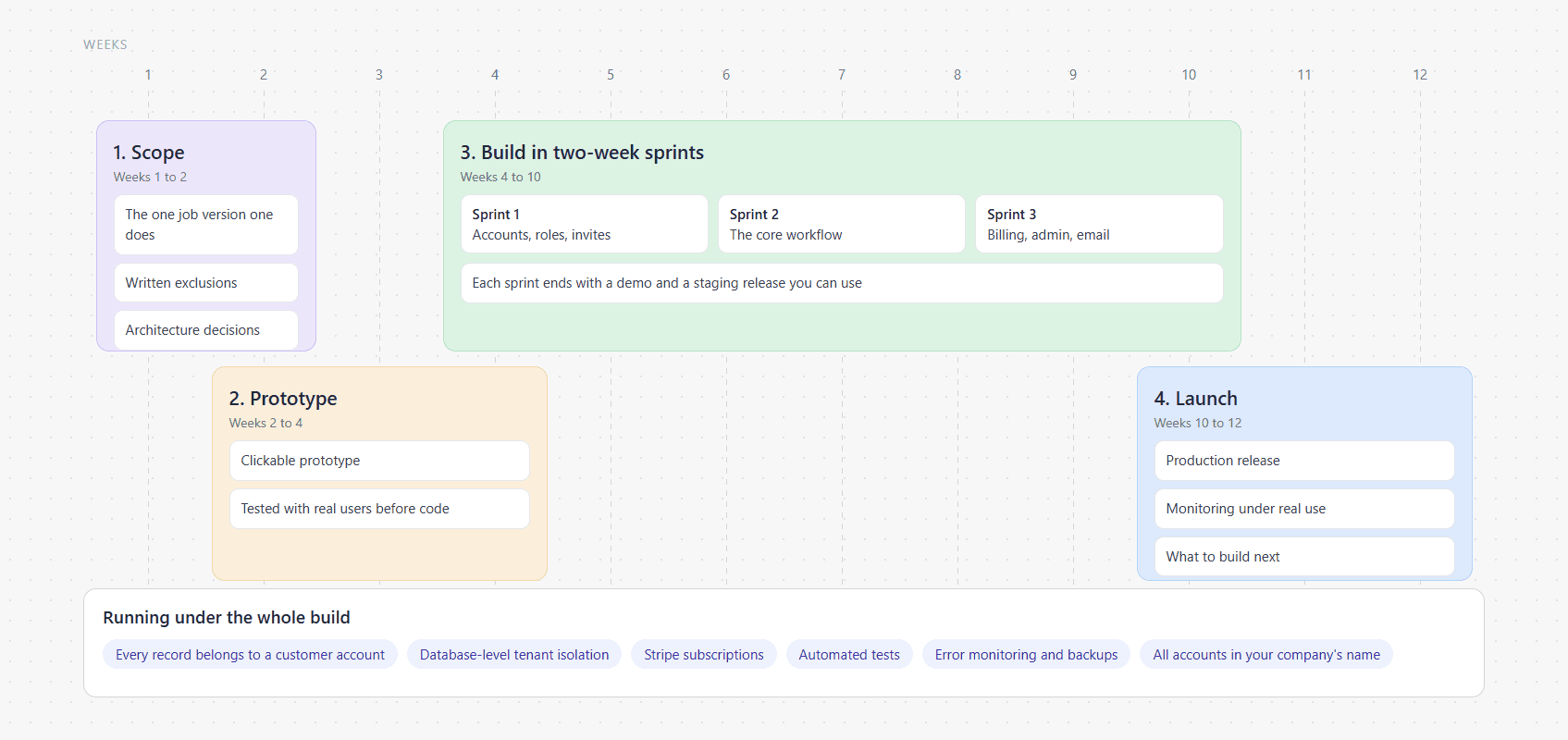
Most well-scoped SaaS MVPs take eight to twelve weeks from the start of scoping to launch. Ours run in four overlapping phases, the same ones listed on our SaaS Development page:
- Weeks 1 to 2: scoping. User journeys, the feature list and its exclusions, and the main architecture decisions, written down.
- Weeks 2 to 4: design and prototype. A clickable prototype tested with real users before code.
- Weeks 4 to 10: build. Two-week sprints, each ending in a demo and a staging release you can use.
- Weeks 10 to 12: launch. Production release, monitoring, and a list of what to build next.
The schedule slips for predictable reasons: the scope grows mid-build, decisions wait on people who aren't in the room, or a third-party integration turns out to work differently from its documentation. A fixed scope with written exclusions protects the date more than anything else.
What drives the cost of a SaaS MVP?
We don't publish prices, because the honest answer depends on the scope. These are the things that move it most:
- How many distinct workflows version one has to support.
- How many roles and permission rules there are.
- Integrations with other systems, especially ones without good APIs.
- Compliance requirements, such as handling health or payment data.
- Whether a design system exists or has to be created.
- How much real-time behaviour the product needs, such as live dashboards or collaboration.
Page count matters much less than any of these. A ten-screen product with complex rules costs more than a thirty-screen one without them. Ask any agency for a fixed quote against a written scope, so the price and the exclusions sit in the same document. Our services page explains how we price, in plain terms.
What should you own when the agency hands over?
Everything, and from the start rather than at the end:
- The code repository, in your organisation's account, with the full commit history.
- The hosting, database, email, monitoring and Stripe accounts, billed to you directly.
- The domain and DNS.
- Documentation: how to run it locally, how to deploy it, and why the main decisions were made.
- Admin access to every third-party service the product depends on.
If an agency hosts your product in its own accounts, your product depends on that relationship continuing. That is how we set up our own SaaS Development engagements: everything is created in the client's accounts in the first week.
Warning signs before you sign
- A price before anyone has asked what the product does.
- No named engineers, or a team that changes after the sales call.
- No written list of what is excluded.
- Hosting, code or payment accounts kept in the agency's name.
- No working software you can open from their past work.
- Promises of a full platform in a few weeks.
A checklist for your first call
- Describe the one job version one must do, and for whom.
- Ask who will build it, and meet them.
- Ask how customer data is kept separate.
- Ask to see working software they built.
- Ask for a fixed quote against a written scope with exclusions.
- Confirm every account will be in your company's name.
- Ask what happens in the first month after launch.
If you're weighing up a build, tell us what you're planning. We'll reply with a written scope, the exclusions included.
Common questions
How long does it take to build a SaaS MVP?
Usually eight to twelve weeks for a well-scoped first version: about two weeks of scoping, two of design and a clickable prototype, six of building in two-week sprints, and two for launch. Products with heavy integrations or compliance requirements take longer. The biggest risk to the date is scope added during the build.
Should I hire an agency, a freelancer or a technical co-founder?
A technical co-founder suits a company whose product is the technology and who will keep building it for years. A freelancer can work well for a narrow build with one main skill. An agency fits when you need design, frontend, backend and infrastructure at once, to a fixed date, and want the work documented for whoever comes next.
Can I build a SaaS MVP with no-code tools instead?
Often, for testing demand. No-code tools are a fast way to prove people want something. They get harder when you need strict separation between customer accounts, complex permissions, or billing logic the tool doesn't support. Many teams validate with no-code, then build the product properly once they have paying users.
What should I leave out of a SaaS MVP?
Anything a paying customer hasn't asked for: a second workflow, native mobile apps, customer analytics dashboards, integrations nobody has named, and enterprise single sign-on. Keep accounts, roles, billing, the core workflow, transactional email, an admin view and monitoring. The rest can follow real demand.
Do I need to know how to code to work with a SaaS development agency?
No, but you need someone on your side who owns the product decisions and turns up to the demos. A good agency explains technical trade-offs in plain language and writes down why each decision was made, so you can make the calls without reading the code.
Who owns the code and the intellectual property?
You should, and the contract should say so. Beyond the contract, check the practical side: the repository, hosting, database, Stripe account and domain should all be in your company's name from the first week, so ownership doesn't depend on a handover at the end.
Want something like this built and run in your own accounts? That's what our SaaS Development service does. You can also see everything we build or look through our case studies.