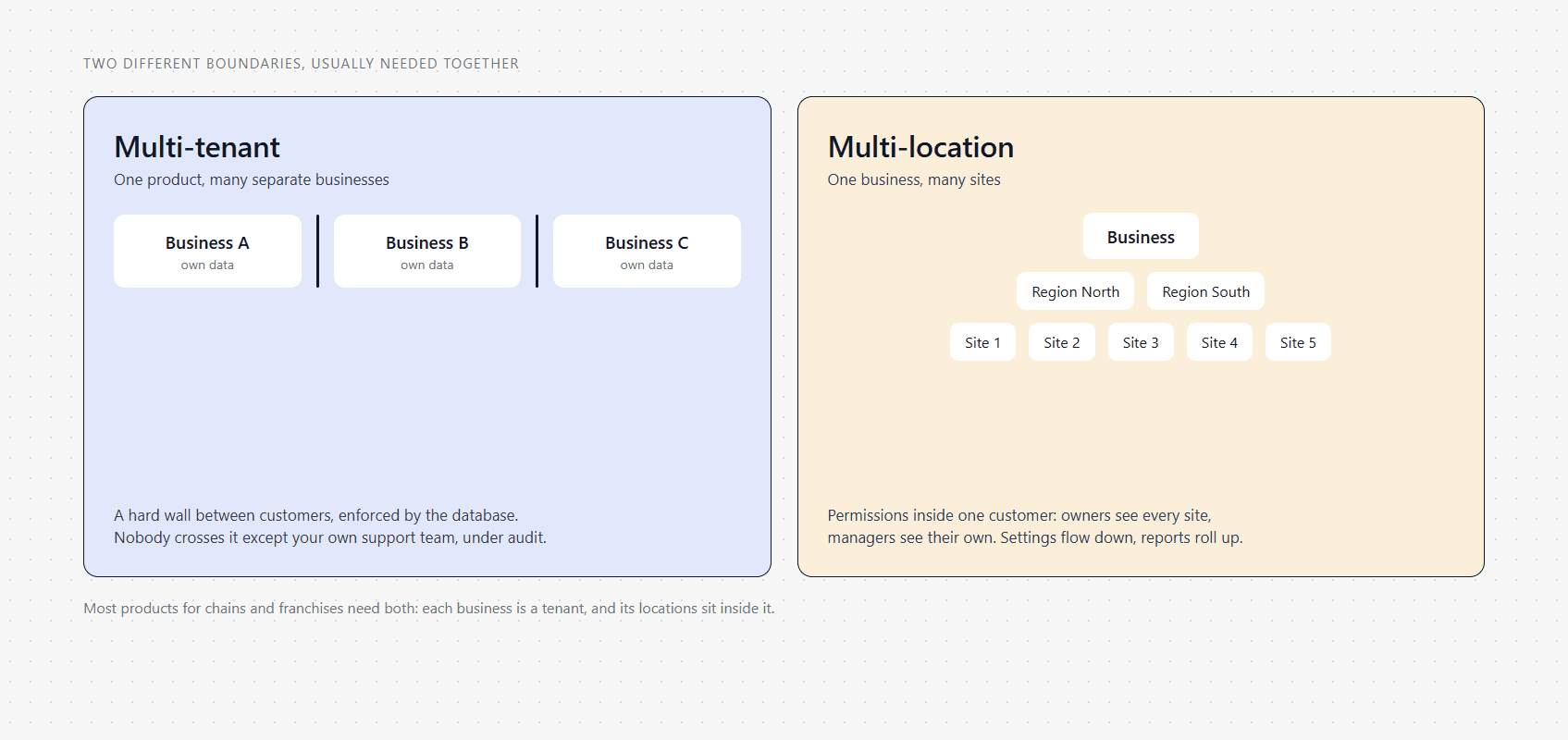
Multi-tenant SaaS means one product serving many separate businesses, with each business's data kept apart. Multi-location SaaS means software for a business that runs several sites, such as branches, stores, clinics or depots. They answer different questions, and most products sold to chains and franchises need both: each business is a tenant, and its locations sit inside it.
Getting the difference right early decides who can see what, how settings flow from head office to each site, and how you bill. This guide covers how to model it, including the hard case of franchises.
What is multi-location SaaS software?
Multi-location SaaS software lets one business run many physical sites from a single account. Head office sets things up once, each location runs its own day, and the owner sees every site side by side. It's common in restaurants, retail, clinics, gyms, field services, cleaning companies and staffing agencies with several branches.
Payment platforms show how basic the idea is. Square's Locations API exists because many sellers use more than one location and need to track where each sale happens. A multi-location product takes that further: staff, schedules, stock, prices and reports all belong to a location as well as to the business.
What is the difference between multi-location and multi-tenant SaaS?
The difference is which boundary you're drawing. Multi-tenant draws a hard wall between separate customers. Multi-location draws softer lines inside one customer, so the right people see the right sites.
- Who the boundary separates: multi-tenant separates different businesses. Multi-location separates sites of the same business.
- How strict it is: a tenant boundary must never be crossed. A location boundary is a permission, and the owner crosses it every day to compare sites.
- What's shared: tenants share nothing but the software. Locations share the business's brand, catalogue, policies and billing.
- Who sees everything: in multi-tenant, only your own support team, under audit. In multi-location, the business owner and head office.
That's why the two shouldn't be mixed up in the data model. Treating each location as a tenant makes head-office reporting and shared settings painful. Treating each business as a location of one giant account puts every customer behind a permission check instead of a wall.
How should you model locations inside a tenant?
Make the business the tenant and the location a level inside it. Every location-owned record then carries both IDs: the tenant ID, which the database uses to keep businesses apart, and the location ID, which the application uses to decide which staff see which site.
A structure that works for most products:
- Tenant: the business. Owns billing, brand settings and the user list.
- Region or area (optional): a grouping of locations for regional managers. Add it when a customer asks; don't force it on small chains.
- Location: a site with its own address, time zone, opening hours and staff.
Roles then follow the hierarchy. An owner sees every location, a regional manager sees their region, and a location manager sees one site. One person can hold different roles at different locations, so store roles per user per location rather than as a single field on the user.
The tenant boundary should still be enforced in the database, as we describe in multi-tenant SaaS architecture. Location permissions are application rules on top of it. If a location check is ever missed, the damage stays inside one business.
How do franchises fit into multi-location SaaS?
Franchises are the hard case, because the brand and each franchisee are separate businesses with their own contracts. You have two broad options:
- The franchisor is the tenant and franchisees are locations. Simple to build, and head office gets full visibility. It works when the brand operates most sites itself, or when franchise agreements give the brand access to site-level data.
- Each franchisee is its own tenant, linked to a parent brand. Franchisees own their customers, staff and finances. The brand pushes down shared things such as menus, price lists, policies and templates, and receives agreed reports back.
The second model is more work but matches how franchises are owned. The question to settle early is what the franchisor is allowed to see, and that's usually answered by the franchise agreement, not by the software team. Write the answer down as part of the scope, because changing it after launch means changing the data model.
How should settings flow from head office to each location?
Settings should be inherited: defined once at the business level and overridden per location only where a site is genuinely different. Opening hours, tax rates, prices, staff rules and notification preferences usually work this way.
- Store settings as data at each level, not as code written for one customer.
- When a location overrides a value, keep the override separate, so a later change at head office still reaches every site that didn't override it.
- Show managers where a value comes from: inherited, or set for this site.
Time zones deserve special care. Each location has its own, so "today's sales" and daily reports must use each site's local day. A chain with sites in several time zones will notice quickly if they don't.
How do reporting and billing work across locations?
Reports should roll up from location to region to the whole business, and let owners compare sites on the same measure. Build them on the location ID that every record already carries, rather than on reports written per customer.
Billing belongs to the tenant, because the business pays, even when the price depends on how many locations it has. Per-location pricing is common in this market, so adding or closing a site should update the subscription quantity automatically, for example in Stripe. In the franchise model where each franchisee is a tenant, each franchisee is usually billed directly.
What about multi-location marketing software?
Multi-location marketing software manages a brand's local presence across many sites: location pages, business listings, reviews and local ads. The data model is the same idea. Each brand is a tenant, each site is a location with its own listings and reviews, and head office manages templates while local managers handle their own replies. If you're building in this space, plan for locations being added and closed often, and for each one having its own public details.
What does a multi-location SaaS MVP need?
A first version needs the hierarchy and the permissions right, and very little else:
- Tenants for businesses, with data separation enforced in the database.
- Locations inside each tenant, with address, time zone and hours.
- Roles per user per location, including an owner who sees everything.
- Business-level settings with per-location overrides.
- Reports that roll up by location.
- Billing on the tenant, with the location count feeding the subscription if you price per site.
What can wait: regions, franchise parent and child tenants, and cross-location stock transfers, unless your first customers need them. Build them when a paying customer does, which is straightforward if every record already knows its tenant and location.
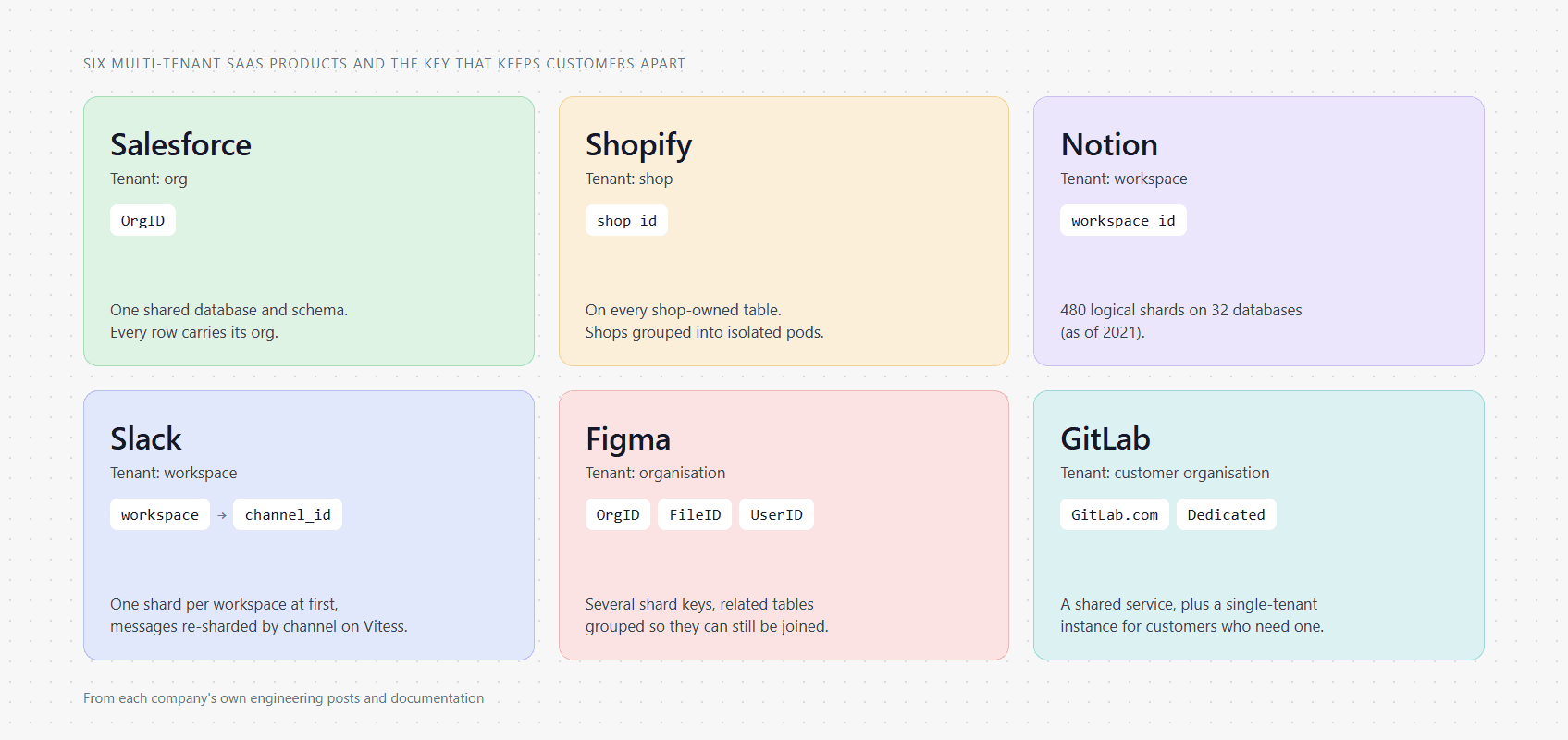
This is the kind of product our multi-tenant SaaS development services are built around, and the same foundations apply to a smaller first version through our SaaS MVP development services. For how well-known products separate their customers, see multi-tenant SaaS examples. If you're planning software for chains or franchises, contact us to get started.
Common questions
What is multi-location software?
Multi-location software lets a business with several sites manage all of them from one account. Head office sets up shared things such as the catalogue, prices and policies, each site runs its own staff, schedule and sales, and owners see reports across every location.
Is multi-location the same as multi-tenant?
No. Multi-tenant means one product serving many separate businesses with their data kept apart. Multi-location means one business with several sites. A product for chains is usually both: each business is a tenant, and its locations are a level inside that tenant.
How should a franchise platform separate franchisee data?
Decide first what the franchisor may see, usually from the franchise agreement. If franchisees own their customers and finances, make each franchisee its own tenant linked to the brand, with shared menus or templates pushed down and agreed reports sent up. If the brand runs the sites, franchisees can be locations inside one tenant.
How is multi-location SaaS usually priced?
Common models are a price per location, a price per user, or tiers that include a number of locations. Whatever the model, billing should sit on the tenant, and opening or closing a location should update the subscription automatically so nobody has to remember to do it.
Can one employee work at several locations?
Yes, if roles are stored per user per location rather than as one role on the user. A shift supervisor at one site can then be a regular staff member at another, and a regional manager can see a group of sites without seeing the whole business.
Want something like this built and run in your own accounts? That's what our SaaS Development service does. You can also see everything we build or look through our case studies.