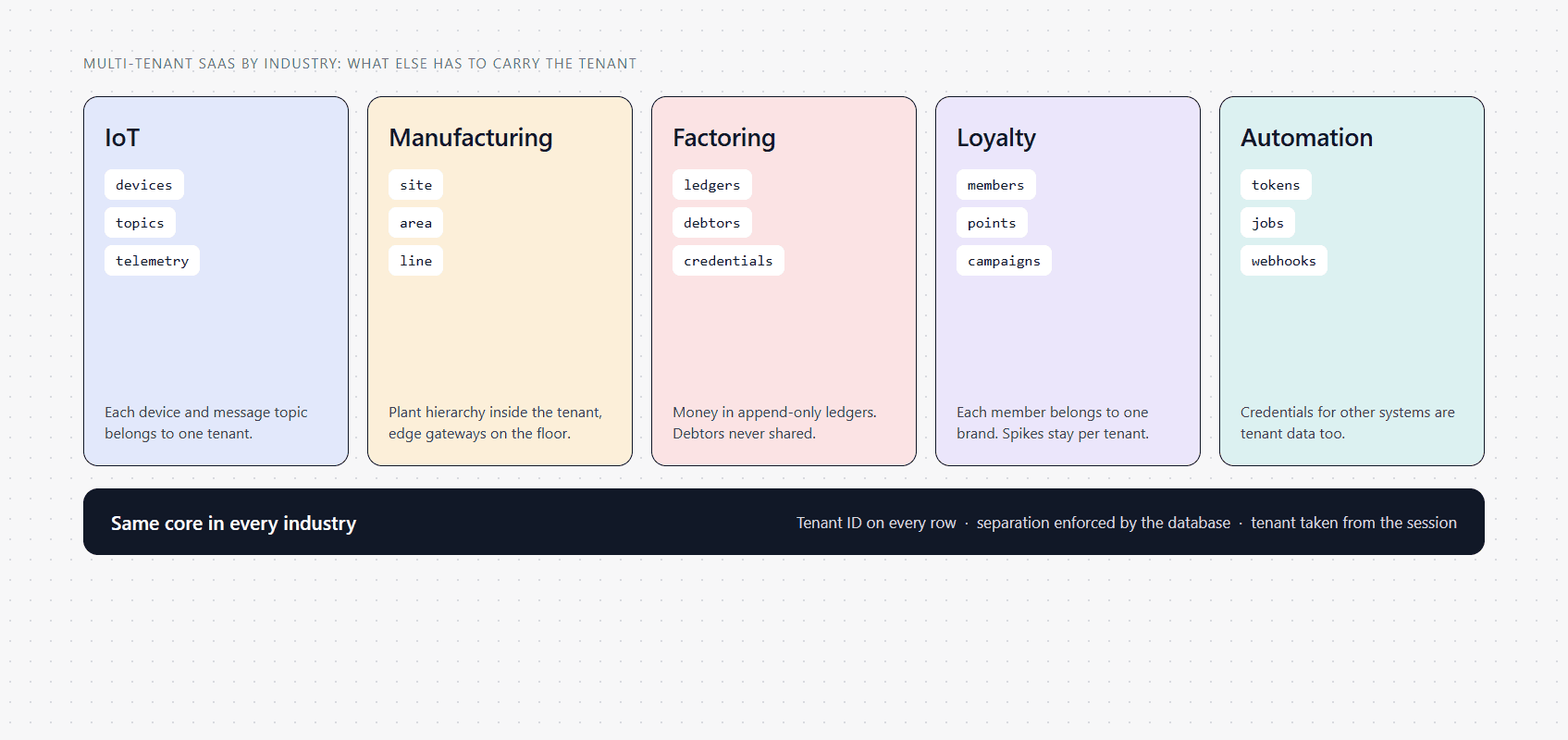
The core of a multi-tenant SaaS product is the same in every industry: a tenant ID on every record, separation enforced by the database, and the tenant taken from the signed-in session. What changes from one industry to the next is what else has to carry the tenant. In IoT it's devices and message topics. In manufacturing it's plants and production lines. In factoring it's money and debtors. In loyalty it's members, and in workflow automation it's other people's credentials.
This guide goes through each, so you can see where the generic patterns are enough and where an industry adds its own rules.
What stays the same in every multi-tenant SaaS?
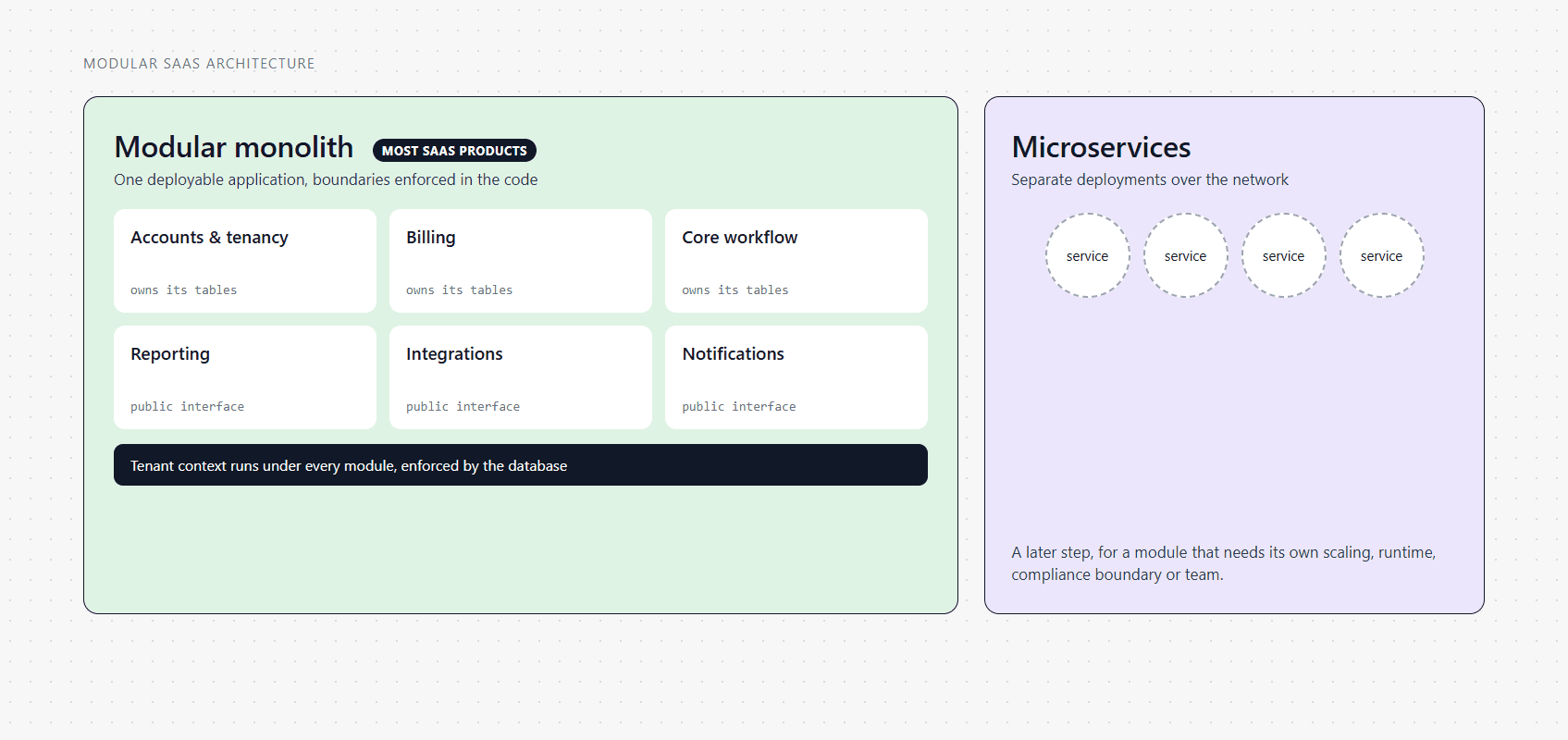
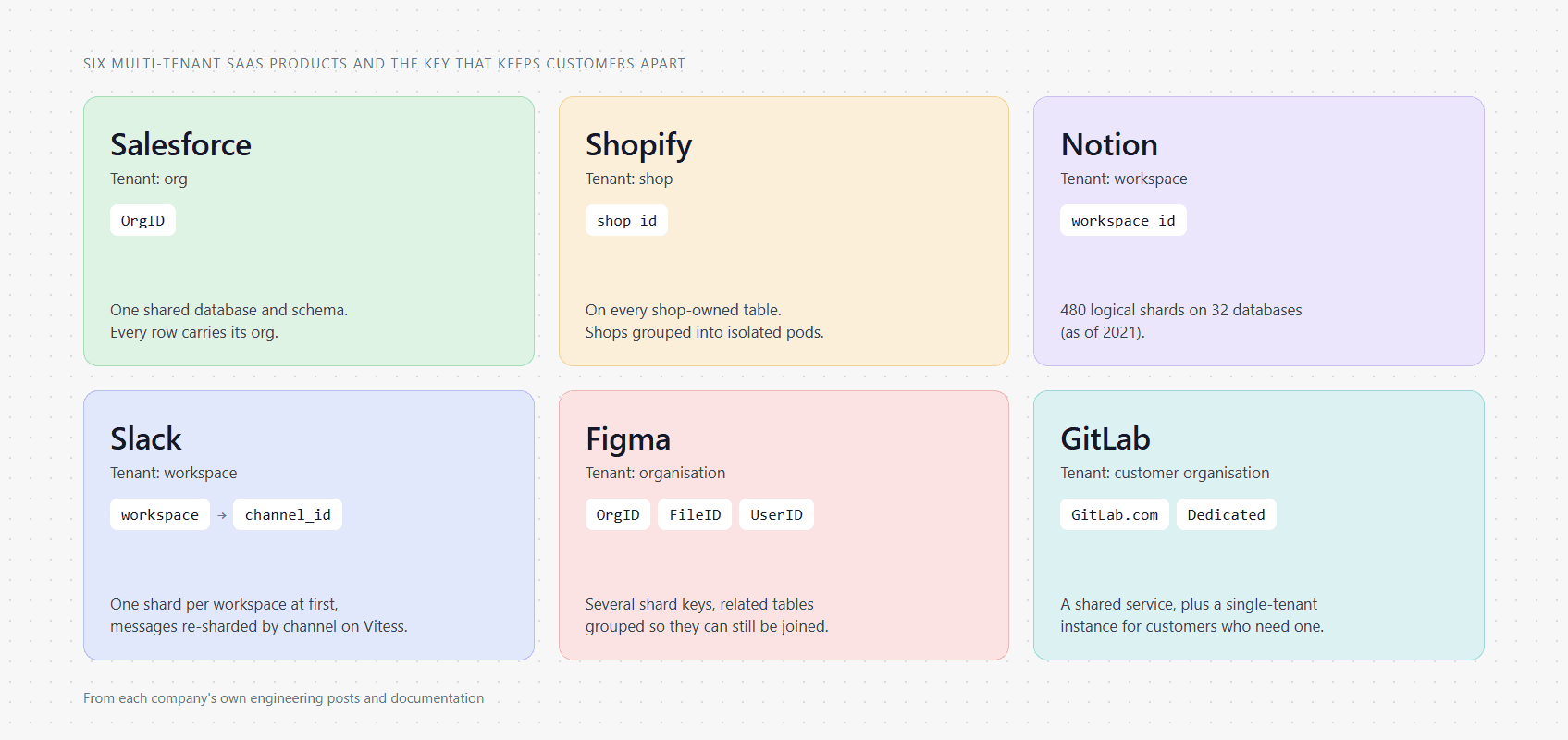
Whatever the industry, the foundations don't change. Every tenant-owned table carries a tenant ID that can't be empty, the database refuses to return another tenant's rows, background jobs and files carry the tenant, and tests try to read across tenants on every release. Our guide to multi-tenant SaaS architecture covers those in detail, and multi-tenant SaaS examples shows how Salesforce, Shopify, Notion and others apply them.
Each industry below starts from that base and adds a few things that also need to know their tenant.
What changes in a multi-tenant IoT SaaS platform?
In a multi-tenant IoT platform, devices are tenant data too, so every device, message and command has to be tied to one tenant. The application database is the easy part. The harder parts are the device connection, the message stream and the volume of data.
- Device identity: each device should authenticate with its own credential, usually a certificate, registered to one tenant.
- Message topics: put the tenant in the topic structure, for example a prefix per tenant and then per device, and have the broker allow each device to use only its own topics. AWS IoT Core supports this with thing policy variables such as the device's registered thing name. Check that names are unique across tenants and that each certificate is attached only to its own device, or the rule won't isolate anything.
- Telemetry volume: sensor readings arrive constantly, so store them in time-series storage partitioned by tenant and time, and set retention per plan.
- Commands: rate-limit commands per tenant, so one customer pushing an update to thousands of devices can't delay everyone else's.
- Device transfers: devices get resold and moved between customers. Make transfer an explicit workflow that moves the device to the new tenant and leaves its old data behind.
What changes in multi-tenant manufacturing and MES software?
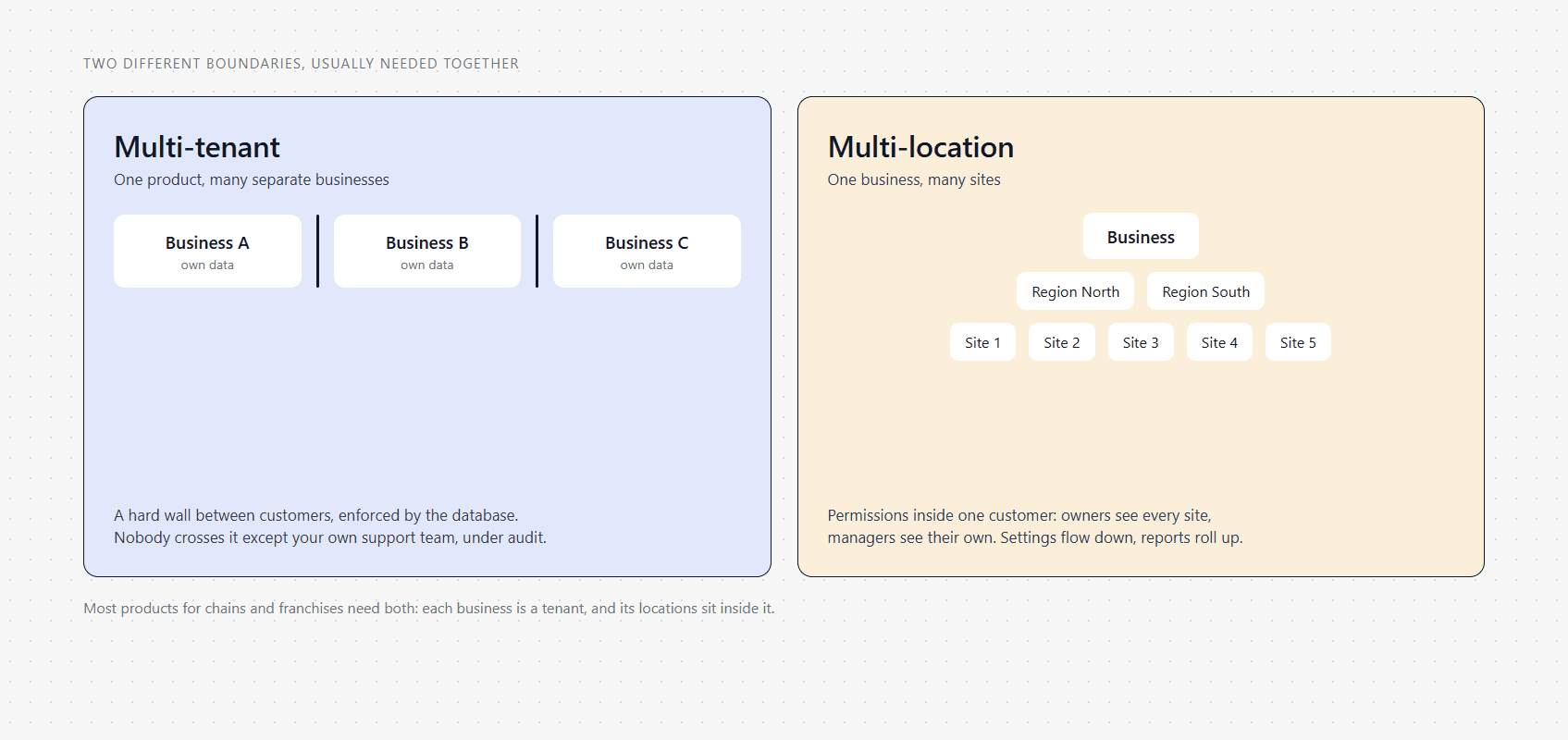
Manufacturing execution systems (MES) add a hierarchy inside each tenant and a factory floor that can't wait for the cloud. The tenant is usually the manufacturer, and below it sits a plant hierarchy that most of the industry describes with the ISA-95 model: enterprise, site, area, work center and work unit. The OPC Foundation's ISA-95 information model lists the same levels.
- Use the hierarchy for permissions: a plant manager sees one site, a line supervisor one work center, and head office every site.
- Plan for lost connections: machines keep running when the internet doesn't. An edge gateway on site should buffer readings and keep line-side screens working, then sync when the link returns.
- Shifts and time zones: production days follow shifts and local time, not the server's calendar, so reports must use each site's own schedule.
- Audit trails: manufacturers in regulated sectors such as food and pharmaceuticals typically need a record of who changed a recipe, a setting or a batch record, and when. Build that into the data model from the start.
- Big tenants: one large manufacturer can produce more data than hundreds of small ones. Design so a single tenant can move to dedicated storage without changing the code.
What changes in multi-tenant factoring and lending software?
In factoring and lending software, each finance company is a tenant, and the data is money: invoices, advances, fees, collections and the debtors who owe them. The tenancy rules are the same, but the cost of a mistake is higher.
- Never share debtors between tenants. The same company can owe money to clients of several factoring firms. It must appear as a separate record in each tenant's books, with no shared credit notes, limits or payment history, unless every party has agreed to a shared data service.
- Use a ledger, not edited balances. Record every movement as an entry that's never changed afterwards, and calculate balances from the entries. Corrections are new entries.
- Keep a full audit trail: who approved an advance, changed a limit or overrode a check, and when.
- Store bank and payment credentials per tenant, encrypted, and never reuse one tenant's connection for another.
- Expect some tenants to need their own database or region, because of a regulator, an auditor or a lender's contract.
What changes in a multi-tenant loyalty platform?
In a multi-tenant loyalty platform, each brand is a tenant and its members belong to it. The same person who joins two brands' programs is two separate members, in two tenants, with two balances. That sounds obvious until someone suggests matching them up for marketing.
- Members belong to one tenant. Coalition programs, where several brands share members and points, are the exception. Design that deliberately, with its own consent and data-sharing rules, rather than by loosening the tenant boundary.
- Points are a ledger. Earning, spending, expiring and reversing points should all be entries, so every balance can be explained to a member who disputes it.
- Campaigns create spikes. A big brand's launch can multiply traffic in minutes. Per-tenant rate limits and queues stop it slowing down every other brand.
- Watch for fraud per tenant: duplicate accounts and unusual redemptions look different for each brand, so thresholds should be set per tenant.
What changes in multi-tenant workflow automation SaaS?
Workflow automation products act on other systems on behalf of each tenant, so the sensitive data isn't only in your database. It's the access tokens and API keys that let your product act inside each customer's other tools.
- Store credentials per tenant, encrypted, and only ever load them inside a job running for that tenant.
- Every job carries the tenant, from the trigger to the last step, including retries.
- Share capacity fairly. One tenant's ten-thousand-row import shouldn't hold up every other tenant's workflows, so queue work per tenant.
- Sign webhooks per tenant, so an incoming event can be traced to exactly one account.
- Keep AI features inside the tenant. If workflows use AI on customer data, don't let one tenant's data shape another's results unless they've agreed to it. Our AI automation work follows the same rule.
Which parts of multi-tenancy change by industry?
Across all five, the pattern repeats. Find everything in your product that holds or acts on customer data, and make sure it carries the tenant:
- IoT: devices, message topics, telemetry and commands.
- Manufacturing: sites, lines, edge gateways and audit records.
- Factoring and lending: ledgers, debtors, credentials and approvals.
- Loyalty: members, points ledgers and campaigns.
- Workflow automation: credentials, jobs, webhooks and AI context.
The database rules are the same everywhere. The industry decides where else the tenant has to travel.
If you're building a multi-tenant product in one of these markets, our multi-tenant SaaS development services start by mapping exactly that. For a first version with less scope, see our SaaS MVP development services, or contact us to get started.
Common questions
Is multi-tenant SaaS safe for financial data?
It can be, when separation is enforced by the database as well as the code, every change is recorded in an append-only ledger with an audit trail, and credentials are stored per tenant. Some finance customers will still need a dedicated database or region for regulatory or contractual reasons, so design the platform to allow that for one tenant without a rewrite.
Can IoT devices be moved from one tenant to another?
Yes, but it should be an explicit transfer, not an edit to the device record. The device gets new credentials or permissions under the new tenant, starts publishing to that tenant's topics, and its historical data stays with the old tenant unless both sides agree otherwise.
Should each factory get its own database in a multi-tenant MES?
Usually not at first. One shared database with tenant and site IDs on every record suits most manufacturers. Move a tenant to dedicated storage when its data volume, a customer contract or a regulation makes sharing the wrong answer.
Can a loyalty member belong to more than one brand?
The same person can join several brands' programs, but each membership should be a separate record in that brand's tenant. Linking them across brands is a coalition program, which needs its own design, consent and data-sharing agreement.
How do you stop one tenant's devices or jobs overloading the platform?
Give every tenant its own rate limits and queue capacity, measure resource use per tenant, and move very large tenants to dedicated resources when they need them. That way a firmware rollout or a huge import slows down only the tenant that started it.
Want something like this built and run in your own accounts? That's what our SaaS Development service does. You can also see everything we build or look through our case studies.