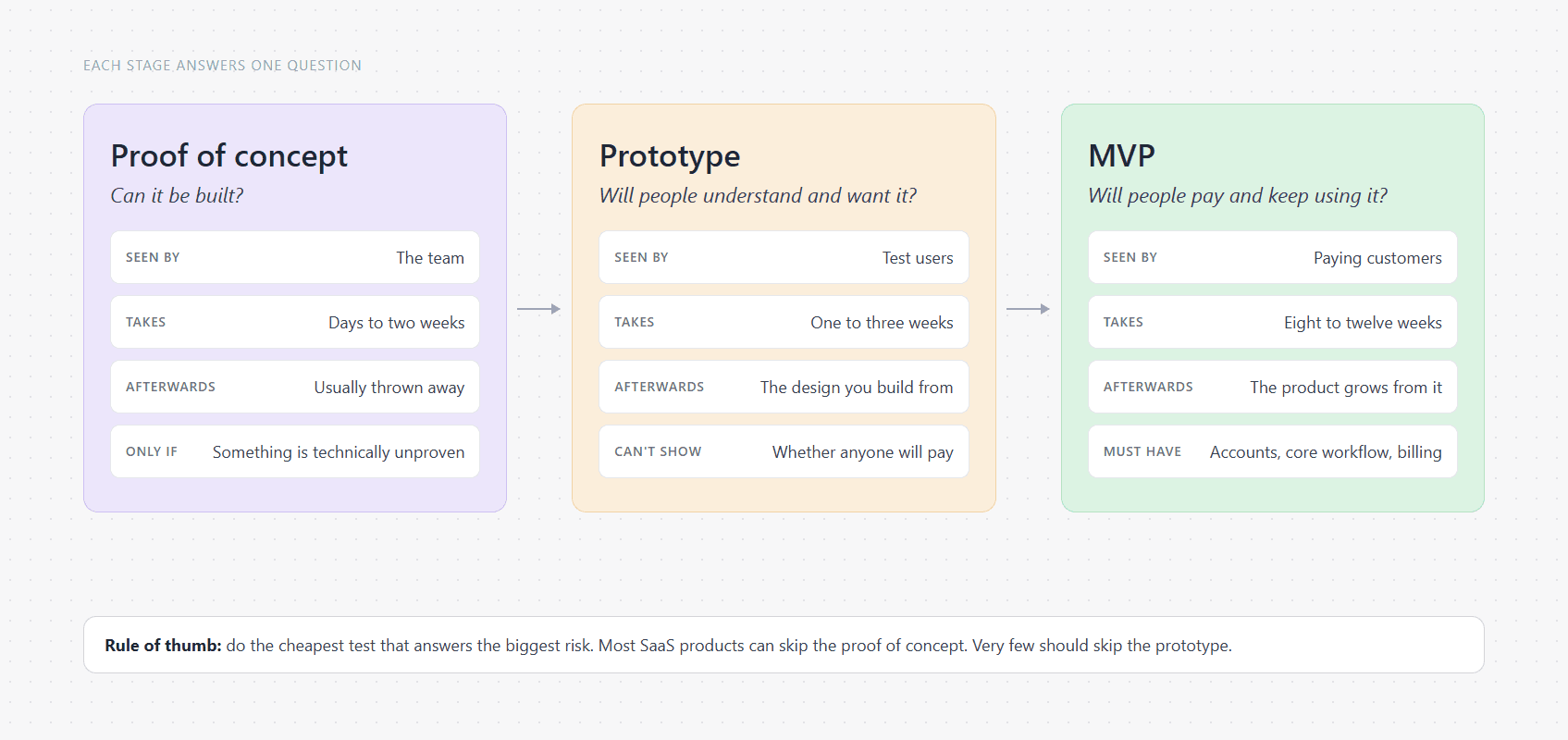
A proof of concept answers "can this be built?", a prototype answers "will people understand it and want it?", and an MVP answers "will people pay for it and keep using it?". Most SaaS products need a prototype before an MVP. A proof of concept is only worth doing when there is a real technical unknown.
The three get used interchangeably, which is how teams end up spending three months building something that a two-week test could have ruled out. Here is what each one is, what it costs you in time, and how to decide.
What is a proof of concept?
A proof of concept, or PoC, is a small technical experiment that shows whether the hard part of an idea works at all. It isn't for customers. Usually nobody outside the team sees it.
You need one when the product depends on something you're not sure is possible. A few SaaS examples:
- An integration with a system whose API you haven't used, and which may not expose the data you need.
- An AI feature where you don't yet know if a model can do the job reliably enough to charge for.
- A performance requirement, such as processing a large file in seconds, that you haven't seen done.
AI features are the most common reason for a proof of concept now: whether a model gets the answer right often enough is something you only learn by trying it on real data. That is a large part of how we approach AI automations, testing on real examples before building around a model.
A proof of concept is usually rough, written quickly and thrown away. Its only output is an answer: yes, no, or yes with conditions.
What is a prototype?
A prototype is a version of the product people can look at and try, built to test whether the idea makes sense to them. Nielsen Norman Group describes a prototype as a hypothesis about a design, something you test by watching people use it.
Prototypes range from sketches on paper to clickable designs that look like the finished product, and occasionally a coded, functional prototype when the experience depends on live data. For a SaaS product, the useful kind is usually a clickable prototype of the core workflow: sign-up, the main screen, the one task the product exists for.
What it can show you:
- Whether people understand what the product does without an explanation.
- Whether the workflow matches how they actually do the job today.
- Which parts confuse them, before any of it is expensive to change.
What it can't show you is whether anyone will pay. People are generous with a prototype because it costs them nothing. That question needs real software.
What is an MVP?
An MVP, or minimum viable product, is the first version of the product that real customers can use and pay for. Eric Ries, who popularised the term, defined it as the version that lets a team learn the most about customers for the least effort, and he was clear that "minimum" doesn't mean low quality.
For a SaaS product that means a working first version: accounts for each customer company (the multi-tenant part), the core workflow finished end to end, and billing. If it can't take payment it can't answer the question an MVP exists to answer. We covered what belongs in that first version, and what to leave out, in how to choose a SaaS MVP development agency.
Unlike the other two, an MVP isn't thrown away. It is the foundation the product grows from, which is why the way it's built matters more than with a prototype.
What is the difference between an MVP, a prototype and a proof of concept?
The clearest way to compare them is by the question each one answers:
- Proof of concept: can it be built? Seen by the team. Days to about two weeks. Usually thrown away.
- Prototype: will people understand and want it? Seen by test users. One to three weeks. Thrown away as code, kept as a design to build from.
- MVP: will people pay and keep using it? Seen by paying customers. Typically eight to twelve weeks for a SaaS product. Kept and extended.
They also fail in different ways. A failed proof of concept saves you from an impossible build. A failed prototype saves you from building the wrong thing. A failed MVP tells you that the market didn't want what you built, which is the most expensive of the three to learn, so it pays to have learned the cheaper lessons first.
Which one does your SaaS product need first?
The MVP vs prototype vs PoC question is really a question about risk: which unknown could sink the product first? Work through these in order:
- Are you sure people have the problem at all? If not, a landing page with a sign-up form can test that before any of the three. It's a quick website development job, and it tells you whether the rest is worth doing.
- Is there something you're not sure can be built? Then start with a proof of concept, and only that part. Don't prototype a product that depends on an unproven integration or model.
- Have you watched people try the workflow? If not, build a clickable prototype and test it with five or six people who have the problem. Their confusion is cheaper now than after launch.
- Do people understand it and say they want it? Then build the MVP, and make it able to charge from day one.
Most SaaS ideas skip the first step, because they combine technology that is already proven in a new way. Very few should skip the second.
Can a prototype become the MVP?
Usually not, and it shouldn't try to. A clickable prototype is a design, not software: it has no accounts, no data and no billing behind it. Its value is the decisions it settles, such as which screens exist and what goes on them.
Proof-of-concept code is the bigger trap. It is written to answer one question quickly, without tests, security or any thought for the second customer. Shipping it as the product is how a team ends up rewriting everything a year later.
The exception is a no-code tool. A product built in one can sometimes serve as an early MVP for a handful of paying users. It gets harder once you need strict separation between customer accounts, complex permissions, or billing the tool doesn't support, and that is usually the point to build it properly. Rebuilding a product that has outgrown its first version is one of the things our SaaS MVP development services cover.
How long does each one take?
Rough guides, assuming one clear question each:
- A proof of concept: a few days to two weeks. If it's running longer, the question is probably too broad.
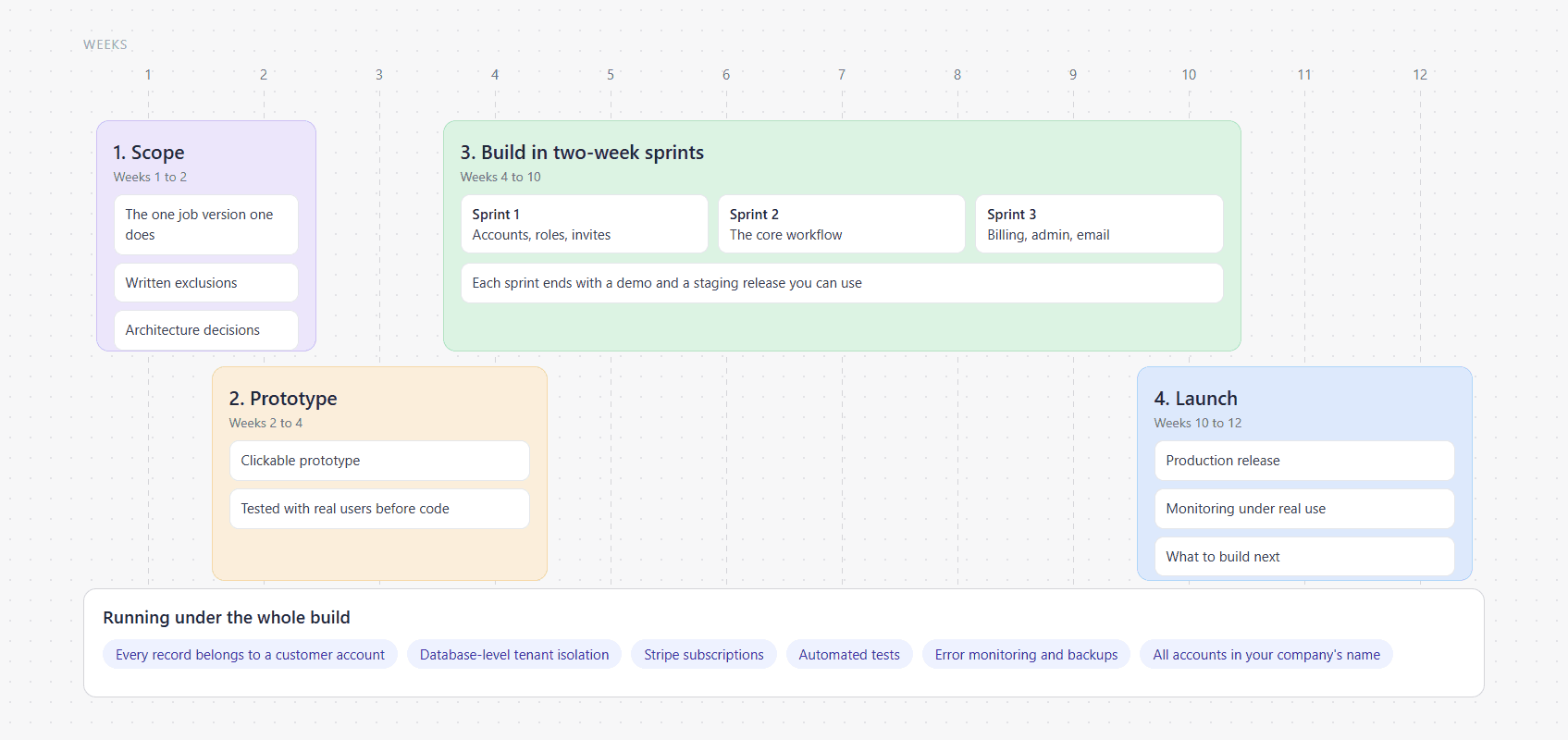
- A clickable prototype: one to three weeks, including testing with users. In our own builds it sits in weeks two to four, before production code starts.
- A SaaS MVP: typically eight to twelve weeks from scoping to launch, as we set out on our SaaS Development page.
Doing all three in sequence adds a few weeks at the front. It routinely saves months at the end.
Common mistakes
- Calling a demo an MVP. If nobody can sign up and pay, it's a prototype, however polished.
- Asking a prototype to prove demand. People like what costs them nothing.
- Shipping proof-of-concept code because it already works.
- Building a proof of concept for technology that is already proven.
- Adding features to the MVP because the prototype looked good. The prototype settles the core workflow, not the wish list.
A quick way to decide
- Write down the single biggest risk to the product.
- If it's "we don't know if this can be built", do a proof of concept.
- If it's "we don't know if people get it or want it", build a prototype.
- If it's "we don't know if they'll pay", build the MVP.
- Do the cheapest test that answers the biggest risk, then move to the next one.
Every concept build in our case studies is a live site you can open and use for the same reason: working software settles questions that slides can't. If you'd like a second opinion on which stage your product is at, contact us to get started.
Common questions
Is a prototype the same as an MVP?
No. A prototype is something people can try so you can see whether they understand and want the product. An MVP is working software that customers can sign up for and pay for. A prototype tests the idea; an MVP tests the business.
Do I need a proof of concept before building an MVP?
Only if part of the product might not be technically possible, such as an unfamiliar integration or an AI feature that has to be accurate enough to charge for. If the product combines technology that is already proven, skip the proof of concept and start with a prototype.
Can I skip the prototype and go straight to an MVP?
You can, but it is the riskiest shortcut. A prototype costs a fraction of an MVP and shows whether people understand the workflow before any production code exists. Skipping it means learning the same lessons after launch, when changes take weeks instead of hours.
Should a prototype be coded or built in a design tool?
For most SaaS products, a design tool is enough. A clickable prototype in a tool like Figma is faster to change and easier to throw away. A coded prototype makes sense when the experience depends on something a design tool can't fake, such as live data or real-time behaviour.
What is the difference between an MVP and a minimum lovable product?
A minimum lovable product is a variation on the same idea that puts more weight on the experience being enjoyable, not just usable. In practice the difference is emphasis. A good SaaS MVP is already pleasant to use in its core workflow; it just leaves out everything outside it.
What comes after an MVP?
Learning from the customers who use it. Watch which features they rely on, where they get stuck and why some leave, then build the next version around that. The first version should be built so those changes are extensions, not a rewrite.
Want something like this built and run in your own accounts? That's what our SaaS Development service does. You can also see everything we build or look through our case studies.