A simple MVP usually takes four to eight weeks, a typical SaaS MVP eight to twelve weeks, and a complex or regulated product four months or more. The biggest factor is scope, not team size: how many workflows, roles and integrations the first version has to support.
These are rough guides, and the range between agencies is wide. What follows is where the time actually goes, what makes builds overrun, and how to shorten one without cutting the parts you'd have to rebuild.
How long does an MVP take by type of product?
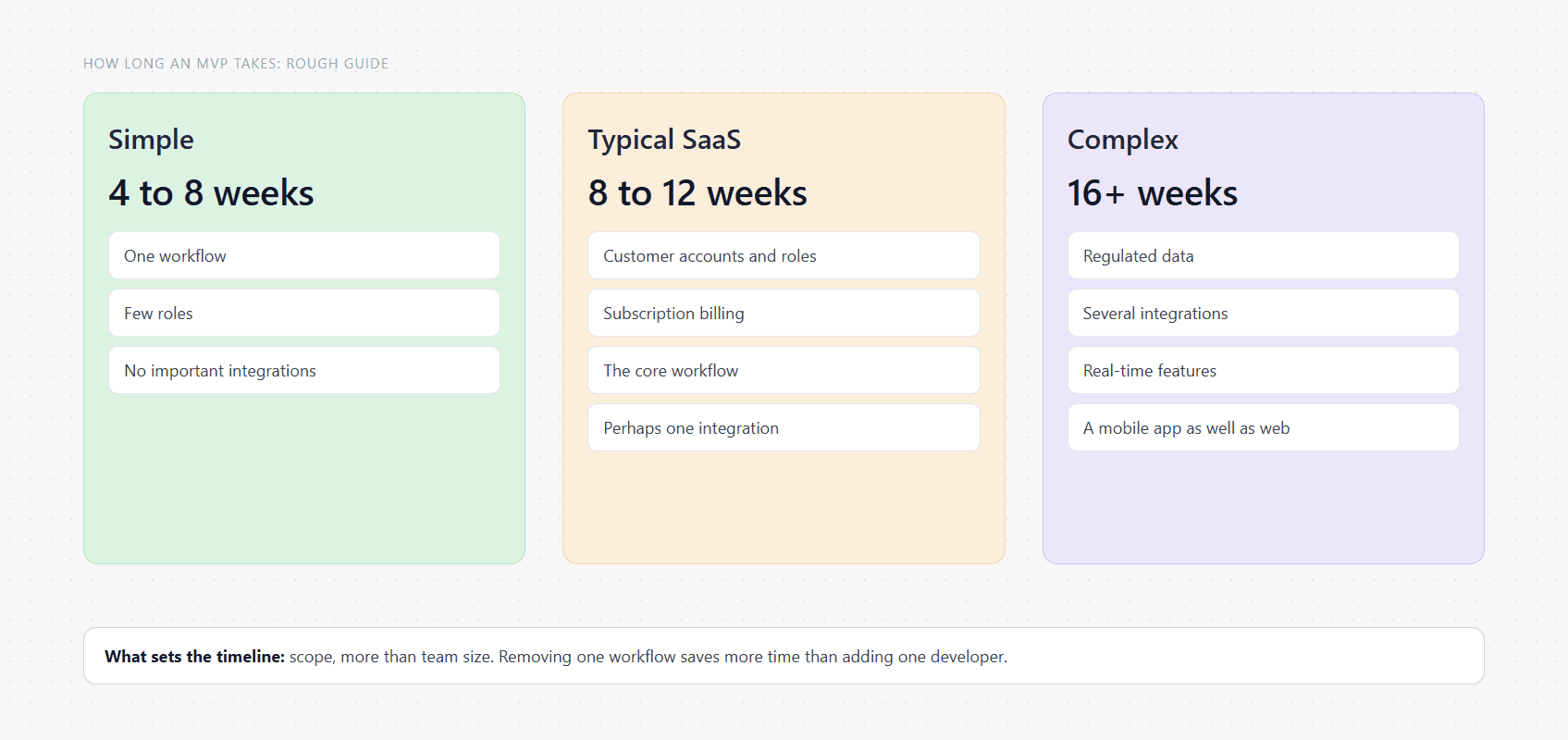
MVP timelines depend mostly on how much the first version has to do: roughly four to eight weeks for a simple product, eight to twelve for a typical SaaS, and sixteen or more for a complex one. In more detail:
- Simple, four to eight weeks: one workflow, few roles, no important integrations. A focused web app or internal tool often fits here.
- Typical SaaS, eight to twelve weeks: customer accounts, roles, subscription billing, the core workflow and perhaps one integration.
- Complex, sixteen weeks or more: regulated data, several integrations, real-time collaboration, or a mobile app as well as the web product.
A no-code version of a simple idea can take days to a few weeks, which is often the right way to test demand first. Our comparison of no-code vs custom development covers when that's enough.
Where does the time go in an MVP build?
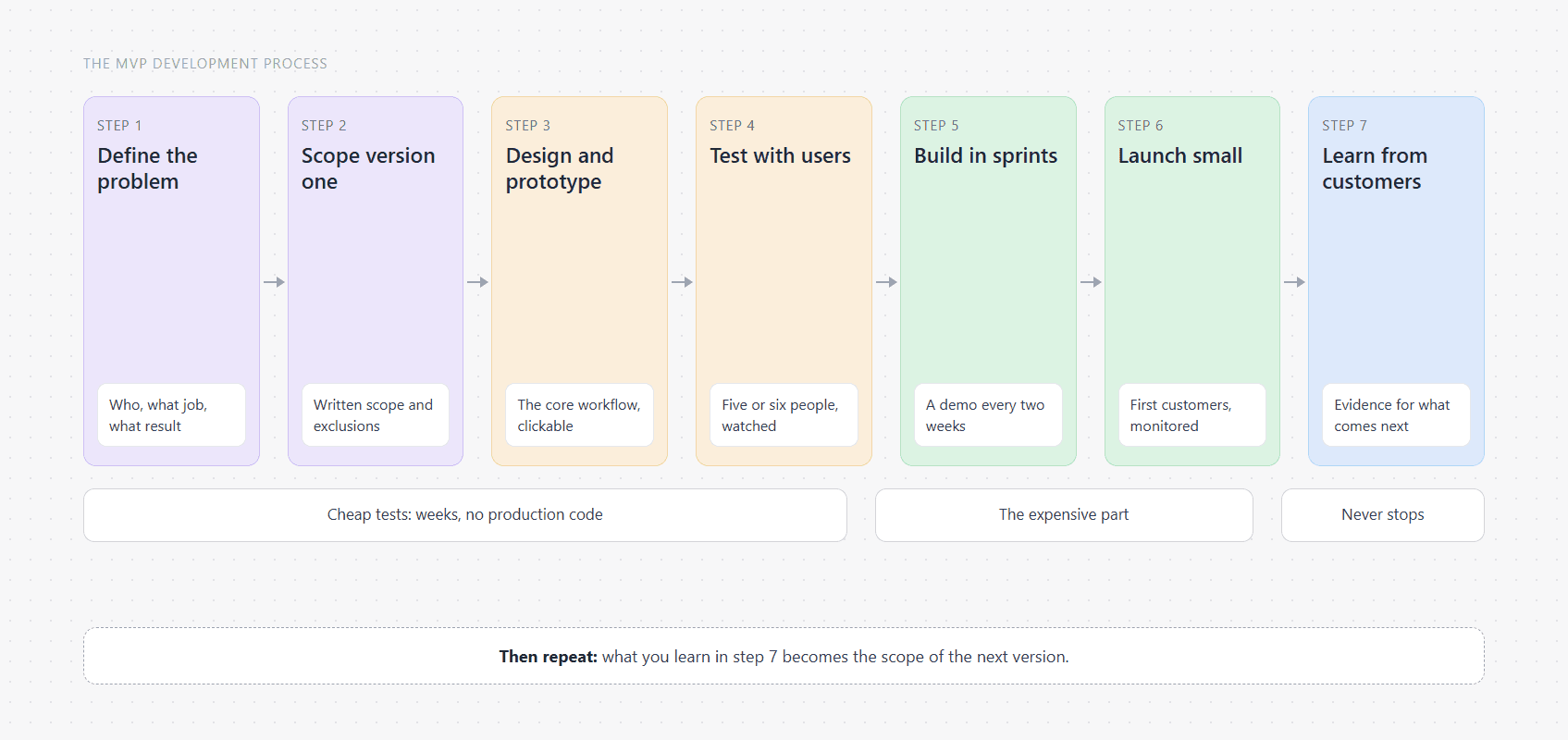
Most of the time in an MVP build goes on engineering, but the weeks before it decide whether that time is well spent. In a typical eight to twelve week SaaS project, it breaks down roughly like this:
- Scoping, about two weeks: user journeys, the feature list, exclusions and the main technical decisions.
- Design and prototype, about two weeks: a clickable version tested with real users.
- Build, about six weeks: two-week sprints with a demo at the end of each.
- Launch, about two weeks: production release, monitoring and fixing what real use uncovers.
The phases overlap, which is how a project can finish in eight weeks even though they add up to twelve. We go through each stage, and what it should produce, in the MVP development process.
What makes an MVP take longer?
An MVP takes longer mainly because the scope grows after work has started. Each addition seems small, but it brings its own design, testing and edge cases. These are the usual causes:
- Scope added mid-build. This is the most common cause by far.
- Slow decisions. A question that waits a week for an answer costs a week.
- Integrations. A third-party system can behave differently from its documentation, or restrict access.
- Compliance. Regulated data adds security work, reviews and paperwork.
- Existing data. Moving records out of an old system takes planning and repeated testing.
- No user testing. Problems found after the build cost far more time than problems found in a prototype.
Only some of these are technical. A clear scope and one person who can make decisions prevent most of them.
Does adding more developers make an MVP faster?
Adding more developers rarely makes an MVP much faster, and past a small team it can slow things down. Every extra person adds coordination, and a first version has many decisions that depend on each other. A focused team of two or three engineers with a designer is usually quicker than a team twice the size.
Timelines shrink more reliably when the scope does. Removing one workflow saves more time than adding one developer.
How can you shorten an MVP timeline?
The safest way to shorten an MVP timeline is to build less, not to build faster. That means cutting scope and removing delays rather than rushing the engineering. In practice:
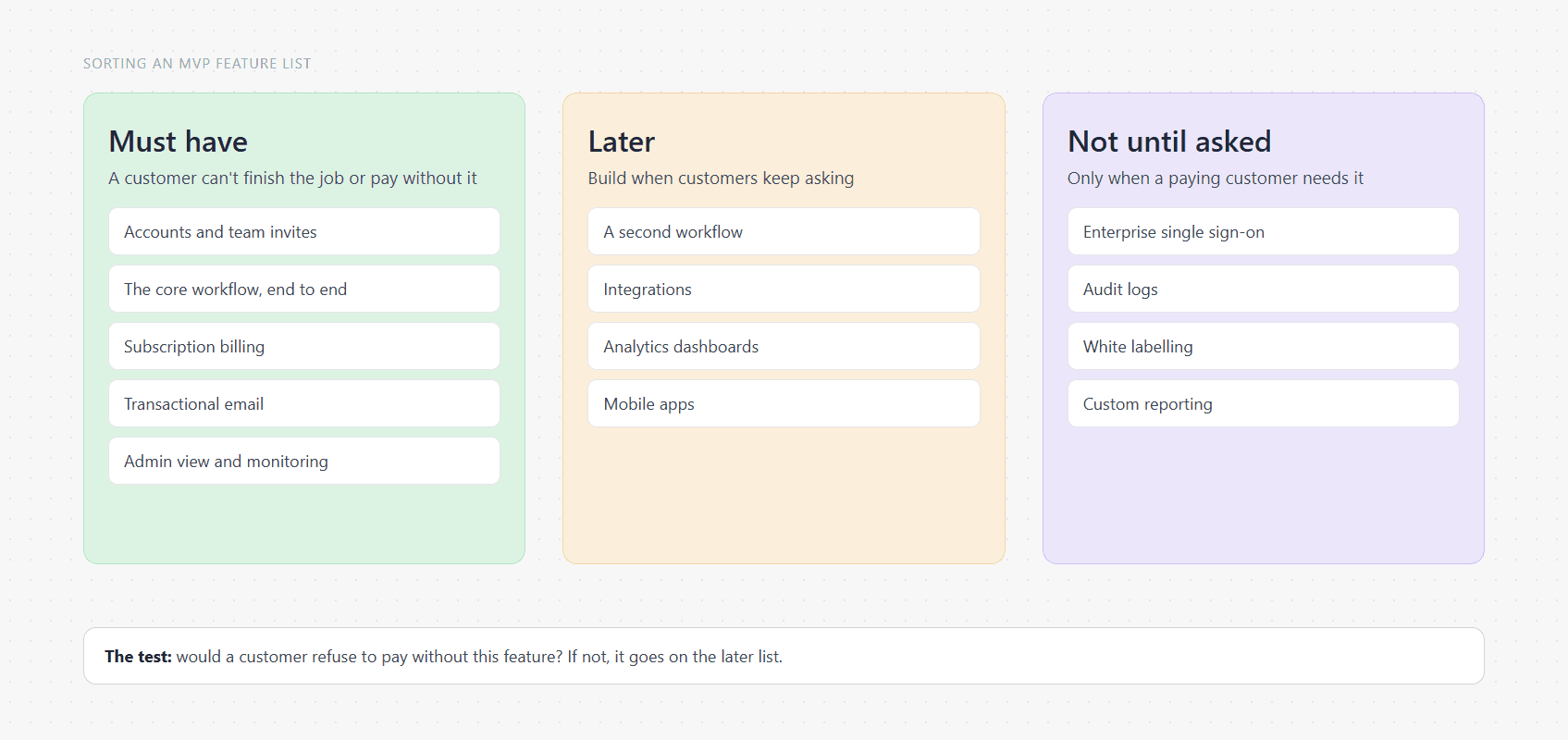
- Cut to one workflow. Our guide to MVP features shows how to decide what stays.
- Test a prototype first. It's the quickest way to remove work you'd otherwise build and throw away. See MVP vs prototype vs proof of concept.
- Use proven services. Don't write your own login, payments or email.
- Name one decision-maker. Someone who can answer questions the same day.
- Fix the scope in writing. A fixed-price contract makes every change a deliberate decision.
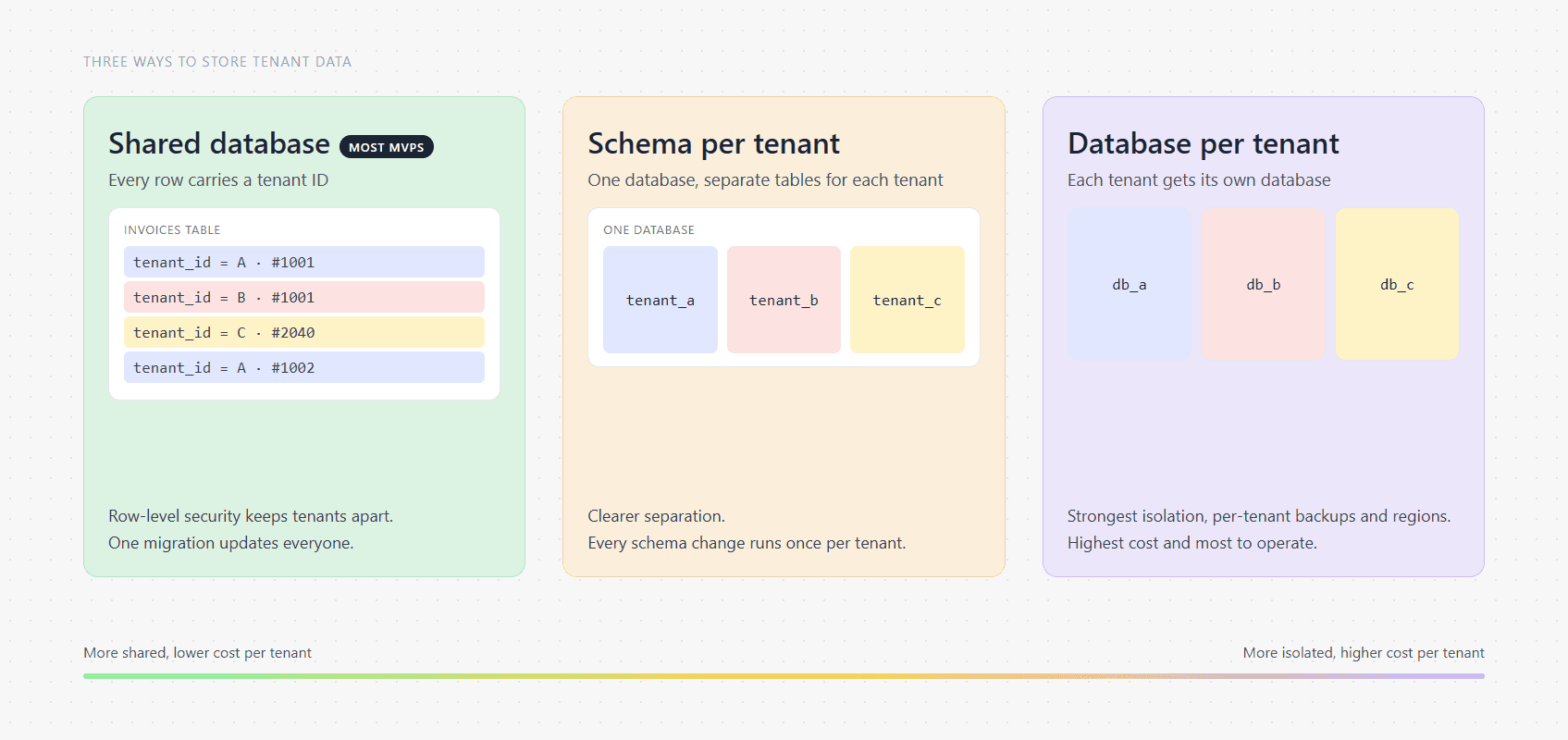
What you shouldn't cut are the things that are expensive to add later: tests on the parts that handle money and data, security, and how customer data is kept separate. We explain the last of these in multi-tenant SaaS architecture.
How do you tell if an MVP timeline is realistic?
An MVP timeline is realistic if it comes with a written scope, shows working software at regular points, and says what's excluded. Be wary of a date with none of those behind it. A few questions help:
- What exactly is included, and what isn't?
- When will I first be able to click on something real?
- Which parts carry the most risk, and what happens if they slip?
- Does the date include design, testing and launch, or only coding?
If a quote is far shorter than others, find out what's been left out. The answer is usually testing, design or everything after launch.
How long does a Cygni Solutions MVP take?
Our SaaS MVPs usually take eight to twelve weeks from the start of scoping to launch. Work typically begins within one to two weeks of signing, and you get a demo and a staging release every two weeks throughout. You can see what that covers on our SaaS MVP development page, and how the timeline connects to the price in our SaaS MVP cost guide.
If you have a date to hit, contact us to get started. We'll tell you on the first call whether it's achievable, and what would need to come out of the scope to make it so.
Common questions
Can you build an MVP in a month?
Yes, if the scope is small: one workflow, few roles and no difficult integrations. A SaaS product with accounts and billing is hard to do well in four weeks, though proven services help. If a month is your limit, cut features rather than testing or security.
How long does it take to build an MVP app for mobile?
A mobile MVP usually takes longer than a web one of the same scope, because of app store review, device testing and often separate work for iPhone and Android. Unless the product needs phone hardware, start with a responsive web app and add native apps later.
What slows down MVP development the most?
Scope changes during the build and slow decisions cause more delay than technical problems do. Both are avoidable. A written scope with exclusions, a list for new ideas, and one person who can give answers quickly protect a timeline better than adding engineers.
Does AI coding make building an MVP faster?
It speeds up writing routine code, which helps, particularly on prototypes. It doesn't remove the slower parts of a project: deciding what to build, testing with users, integrating other systems and checking the result. Generated code still needs an experienced engineer to review security and data handling.
How long should you test an MVP after launch?
Plan on at least several weeks of real use before drawing conclusions, because you need to see whether customers return, not just whether they sign up. How long depends on how often they'd naturally use the product. Weekly-use products need longer than daily ones.
Is it better to launch early or wait until the MVP is more finished?
Launch once a customer can finish the core job without help and you can take payment. Waiting past that point mostly delays what you need to learn. Launch to a small group first, so any rough edges reach people you can talk to directly.
Want something like this built and run in your own accounts? That's what our SaaS Development service does. You can also see everything we build or look through our case studies.